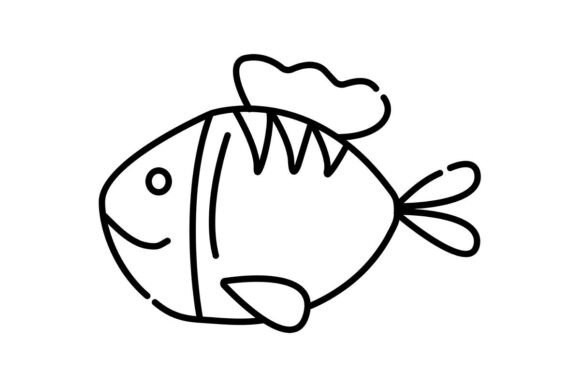
Evaluating Fish Black and White Line Illustration for Design Projects
In the realm of graphic design, simplicity often communicates more effectively than complexity. The Fish Black and White Line Illustration has emerged as a versatile asset for designers, marketers, and content creators seeking clarity and elegance. This specific style features a minimal, cute outline drawing of a fish, rendered entirely in black and white vector lines. Its clean aesthetic makes it suitable for a wide array of applications, from branding to educational materials. Understanding the nuances of this illustration style is essential for determining whether it aligns with your project goals.
Understanding the Aesthetic and Technical Composition
A Black and white vector line illustration of a fish is defined by its lack of color, shading, or intricate textures. Instead, it relies on stroke weight, curvature, and negative space to define the subject. The "cute" aspect typically implies rounded edges, exaggerated proportions such as larger eyes or fins, and a friendly demeanor, distinguishing it from scientific or realistic biological diagrams.
Technically, these illustrations are usually created as vector graphics. This means they are composed of mathematical paths rather than pixels. The primary advantage of this format is scalability. Whether the image is printed on a small business card or enlarged for a storefront sign, the lines remain crisp and sharp. This technical foundation is crucial for professionals who require flexibility across various media formats without losing quality.
Strategic Applications and Use Cases
The versatility of the Fish Black and White Line Illustration allows it to function effectively in diverse industries. Evaluating where this style fits best can help you decide if it is the right choice for your current needs.
- Seafood Restaurant Logos: For culinary establishments, particularly those focusing on fresh catch or sustainable fishing, a minimal line art fish conveys freshness and simplicity. It avoids the visual clutter of complex logos, making it easily recognizable on menus, signage, and uniforms.
- Ocean-Inspired Packaging: Brands selling marine-related products, such as skincare ingredients derived from seaweed or sustainable seafood items, benefit from the clean look. The black and white scheme suggests purity and transparency, which are valuable brand attributes in these sectors.
- Kids’ Books and Coloring Pages: The "cute" outline style is inherently approachable for children. In educational contexts, these illustrations serve as excellent templates for coloring activities. The clear, unbroken lines make it easy for young users to stay within boundaries, fostering engagement and motor skill development.
- Decorative Aquatic Projects: Interior designers and crafters often use these vectors for wall decals, textile prints, or stationery. The monochromatic nature allows the illustration to blend seamlessly with various color palettes, acting as a neutral yet thematic decorative element.
Benefits of Minimalist Line Art
Choosing a minimal and cute outline style offers several distinct advantages over more detailed or colorful alternatives. First, there is the aspect of cognitive load. Simple images are processed faster by the human brain. In advertising and branding, this means the message is conveyed instantly. A viewer does not need to decipher complex details to understand that the image represents a fish.
Second, the black and white format ensures high contrast. This is particularly beneficial for accessibility. High-contrast images are easier for individuals with visual impairments to distinguish. Furthermore, in print production, black ink is often cheaper and more consistent than multi-color printing processes. Using a single-color vector can reduce production costs for large runs of packaging or promotional materials.
Third, the vector format provides future-proofing. As display technologies evolve and resolution standards increase, vector graphics remain relevant. You will not need to recreate the asset for higher-resolution screens or larger print formats, saving time and resources in the long term.
Tradeoffs and Limitations to Consider
While the Fish Black and White Line Illustration is highly functional, it is not a universal solution. There are tradeoffs that designers and decision-makers must acknowledge. The most significant limitation is the lack of emotional depth that color and texture can provide. A full-color, realistic illustration might evoke a stronger sense of appetite or wonder, which could be necessary for certain high-end culinary campaigns or immersive storytelling experiences.
Additionally, the "cute" stylization may not suit all brand identities. For companies aiming to project authority, luxury, or scientific rigor, a cartoonish or minimal outline might appear too informal or juvenile. In such cases, a more detailed, anatomically accurate, or serif-typography-integrated design might be more appropriate.
Another consideration is differentiation. Because minimal line art is popular and relatively easy to produce, the market is saturated with similar assets. If you use a stock vector without customization, your brand risks looking generic. To mitigate this, consider modifying the line weight, adding unique geometric elements, or combining the fish illustration with custom typography to create a distinct visual identity.
When to Choose Alternatives
There are specific scenarios where alternatives to the Black and white vector line illustration of a fish may be worth considering. If your project targets a demographic that responds strongly to vibrant visuals, such as tropical tourism marketing or children’s entertainment apps, a full-color raster image might yield better engagement. Color psychology plays a significant role in these contexts, where blues, greens, and oranges can evoke feelings of calm, nature, or energy.
Furthermore, if the illustration needs to convey specific species information for educational or scientific purposes, a minimal outline may omit critical details. In these instances, a detailed biological illustration or a photograph would be more effective. The goal of the communication should dictate the style; if accuracy is paramount, minimalism may sacrifice too much information.
Practical Decision-Making Insights
To determine if a Fish Black and White Line Illustration aligns with your goals, ask yourself the following questions:
- What is the primary medium? If you are designing for print, especially in black and white or limited color schemes, this style is ideal. For digital-only platforms where animation or interactivity is key, consider if a static vector meets your needs or if a more dynamic asset is required.
- Who is the audience? For children, general consumers, or audiences appreciating modern minimalism, this style works well. For niche experts or luxury markets, evaluate if the simplicity matches the perceived value of your product.
- What is the brand personality? If your brand values transparency, sustainability, and approachability, the clean lines and lack of hidden details in this illustration style reinforce those values. If your brand is about excitement, drama, or opulence, look for richer visual styles.
Ultimately, the minimal and cute outline style is a tool for clarity. It strips away the non-essential to highlight the form. When used strategically, it enhances user experience and brand recognition. However, it requires careful contextual placement to ensure it does not appear overly simplistic or out of place. By weighing the benefits of scalability and cost-efficiency against the limitations of emotional range and differentiation, you can make an informed decision about incorporating this illustration into your design toolkit.
Whether you are developing a new logo for a seaside café, creating educational content for young learners, or designing eco-friendly packaging, the Fish Black and White Line Illustration offers a balanced, professional, and adaptable solution. Its enduring appeal lies in its ability to communicate effectively without noise, making it a prudent choice for many modern design challenges.